| International Conference of the 7th A-WEB General Assembly: Technology, Trust and the Voter | ||||||||||||||||||||||||
|---|---|---|---|---|---|---|---|---|---|---|---|---|---|---|---|---|---|---|---|---|---|---|---|---|
| Last updated 2026-10-29 | ||||||||||||||||||||||||
|
International Conference of the 7th
A-WEB General Assembly: Technology, Trust and the
Voter Election officials from around the world
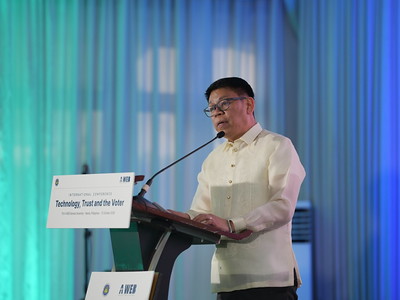
met in Manila on 15 October 2026 for the International Conference of the 7th
A-WEB General Assembly, co-organized by A-WEB and COMELEC. COMELEC Commissioner
Aimee P. Ferolino opened the day, welcoming delegates of A-WEB and the
Association of Asian Election Authorities (AAEA). Presentations were given in
English and Spanish, with interpretation in five languages. The sessions were
moderated by Atty. Edgar Feliciano D. Aringay and Dir. Genesis M. Gatdula of
COMELEC.
Before the vote: information under
pressure Mr. Rakesh Kumar Verma, Director General of
IIIDEM of the Election Commission of India, explained that India has no
stand-alone law on disinformation. Instead, it used its constitutional and
electoral powers to require labelling of AI-generated campaign content, a
three-hour takedown rule and disclosure of creators, leading to the removal of
about 11,000 non-compliant posts. Mr. Pablo Iván Rodríguez, Director of the
Electoral Political Observatory of Argentina's National Electoral Directorate
(DINE), reported 31 AI-related incidents in the country's 2025 elections and
called for clearer protocols and stronger digital literacy ahead of 2027. Dir.
John Rex Laudiangco of COMELEC noted that voluntary agreements with 11
technology platforms have cut takedown times from about three months to 24
hours.
On reaching voters directly, Dr. Uuc-kib
Espadas Ancona, Electoral Councilor of INE Mexico, presented the Certeza INE
verification program and the WhatsApp assistant Inés, cautioning that public
trust in the institution (53% in 2026) does not mean voters turn to official
sources. Commissioner Anna Grigoryan of the CEC of Armenia set out a strategy
of proactive communication, digital tools and accessible voter information, and
Mr. Giorgi Kalandarishvili, Chairperson of the CEC of Georgia, described how
the Commission met nearly half of the country's 3.5 million voters in person
before introducing new voting technologies in 2024.
AI inside the institution Ms. Jona Josifi, General Director of
Electoral Administration at the CEC of Albania, shared the Commission's 2025
pilot of AI-assisted counting in Tepelenë, run in parallel with the legally
binding manual count. Across 21 ballot boxes the system recorded 4,291 ballots
against 4,293 counted by hand, but it differed on invalid ballots (102 vs.
117): detecting ballots proved easier than interpreting voter intent. A larger
pilot is planned for 2027. Speaking for the A-WEB Secretariat, Ms. Jinju
Jo, Director of the Electoral Research and Observation Department, drew on the
2026 Summit for Democracy hosted by INE Mexico and its regional forums. AI
should be introduced where it is genuinely needed; implementation can be
outsourced, but decisions and responsibility cannot; and human oversight means
someone who can explain, override and answer for a result in public. Mr.
Mohamed Shakeel, President of the Elections Commission of the Maldives, and Ms.
Tiaituau Tagata, Assistant Electoral Commissioner of Samoa, agreed that AI may
support, but must not replace, human responsibility. In the plenary, IIIDEM
introduced its draft global model AI strategy for EMBs, now circulated for
comment.
Delivering and proving the results In COMELEC's host spotlight, Atty. Helen
Aguila-Flores described delivering elections across more than 7,600 islands
through heat waves, typhoons and earthquakes, and paid tribute to the public
school teachers who serve on electoral boards. Dr. Irena Hadžiabdić,
Member of the CEC of Bosnia and Herzegovina, speaking just 11 days after the
country's general election, reported its first use of biometric voter
identification and ballot scanners, with full preliminary results published an
hour after polls closed. She stressed that timely budgets, legislation and
training are essential. Mr. Fausto Javier Von Streber Alfonzo of Paraguay's
TSJE presented its preliminary results transmission system (TREP) and its
electronic voting machine with a printed ballot, and Dir. John Rex Laudiangco
demonstrated COMELEC's automated counting machine (ACM). Atty. Jayvee E.
Villagracia and Dir. Rafael B. Olaño, Deputy Executive Director for Operations,
joined as discussants from COMELEC.
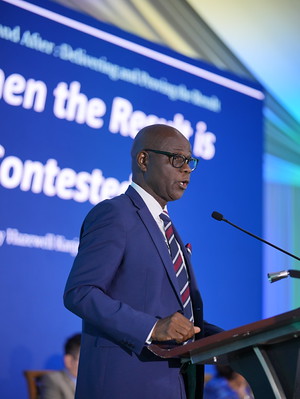
When results are contested Dir. Allen Francis B. Abaya of COMELEC's
Electoral Contest Adjudication Department outlined the Philippine system of
electoral tribunals and noted that no court has yet ruled on AI-generated
evidence in an election contest. Commissioner Judge Dhayanithie Pillay of the
IEC of South Africa, together with Commissioner Dr. Chelete Monyane of the IEC
of Lesotho and Commissioner Harry Hazewell Kanjewe of the Malawi Electoral
Commission, compared legal frameworks. They agreed that transparent processes,
timely dispute resolution and continued engagement with stakeholders are what
keep results accepted.
Looking ahead Closing the conference, COMELEC Executive
Director Atty. Teopisto E. Elnas Jr. observed that electoral systems differ but
the challenges are shared, and that cooperation through A-WEB lets EMBs learn
from one another. A-WEB thanks COMELEC for hosting and all speakers and
participants for a day of open exchange. The Secretariat will share the
outcomes of the 2026 Summit and the Asia regional forum with members when they
become available.
|